
Practitioner-Led Research
The Strategic Management of Visual Assets in Public Relations: Photography, Trust and Editorial Use
Abstract
Strategic management of visual assets in public relations (PR) refers to the planned creation, organisation, deployment, and long-term use of photography and visual content to support organisational communication goals. In contemporary PR practice, visual assets function not merely as creative outputs but as strategic resources that influence reputation, trust, and audience perception across editorial and corporate media channels.
This practitioner position paper examines the transition of public relations from a predominantly text-led discipline to a visual-centric paradigm, commonly described as the “Visual Turn”. Drawing on thirty-five years of professional experience at the intersection of newsroom practice and corporate communications, the author introduces the Strategic Hinge framework to distinguish visual assets commissioned as a Record (informative) from those produced as a Product (persuasive).
The paper identifies Visual Drift as a significant risk to institutional credibility and proposes a model of Visual Governance to safeguard editorial integrity across complex organisations. In an era increasingly shaped by synthetic media and AI-mediated newsrooms, the research argues that human-verified metadata and practitioner-led stewardship now function as primary safeguards of institutional legitimacy and the public record.
Introduction: Thirty-Five Years at the Intersection
When I first stepped onto a picture desk in the North of England more than thirty-five years ago, the pace of the job was dictated by the darkroom. Film had to be developed, prints processed, captions written by hand, and deadlines were measured in hours rather than seconds. The boundaries within photography were clear and, for the most part, rigid. You were either a press photographer working for the news agenda, or a commercial photographer producing images for a client. There was little overlap, and even less confusion about purpose.
In the decades since I founded United National Photographers in 1997, those boundaries have steadily eroded. Public relations has expanded, media platforms have multiplied, and photography has moved from the margins of communication to its centre. Today, images are often the first and most powerful way in which an organisation is encountered. For students entering the profession, this visual dominance often feels both intuitive and overwhelming.
This paper is written from practice rather than theory alone. It reflects long-term professional experience working with newsrooms, public institutions and national organisations, and observing how images succeed or fail once they leave the hands of the commissioning team. Its purpose is not to provide a technical guide to photography, but to help public relations practitioners think more clearly about why images are commissioned, how they are used, and what responsibilities accompany their circulation.
One of the central arguments developed here is that many visual failures in public relations do not stem from poor photography, but from poor strategic understanding. Images are frequently commissioned without a clear sense of their intended destination. As a result, organisations supply photographs that feel neither credible to journalists nor effective for internal or corporate use. The problem is not quality, but misalignment.
To address this, the paper introduces a simple but powerful distinction between images produced as a Record and those created as a Product. This distinction is not theoretical; it reflects everyday decisions made by picture editors, communications officers and photographers. Understanding it allows practitioners to commission imagery more deliberately, avoid reputational risk, and preserve trust in an environment increasingly shaped by speed, automation and synthetic media.
For students of public relations, visual literacy is no longer optional. Photography now sits alongside writing as a core professional skill, not because practitioners must take photographs themselves, but because they must be able to judge, manage and deploy them intelligently. The sections that follow aim to provide that framework, grounded in real-world practice rather than abstract theory.
The Visual Paradigm: From Text to Visual Authority
For much of the twentieth century, public relations was a text-led discipline. Press releases, briefing notes and official statements sat at the centre of professional practice, while photography was often treated as supporting material. Images were commissioned late, added to illustrate a message that had already been written and agreed. In that environment, photography was helpful, but rarely decisive.
That hierarchy has now reversed. In contemporary public relations, images often lead the communication rather than follow it. A photograph is frequently the first point of contact between an organisation and its audience, whether that audience is a journalist scanning a picture desk, a stakeholder scrolling on a mobile phone, or a member of the public encountering an institution through a news feed.
This shift is sometimes described as the visual turn. In practical terms, it reflects changes in how media is consumed and distributed. Digital publishing environments prioritise immediacy, and social platforms reward content that can be understood instantly. Images travel faster than text and, crucially, they are often interpreted before any accompanying explanation is read.
From long experience, this change has had a profound effect on how organisations are judged. A well written press release can be undermined by a weak or confusing photograph, while a strong image can secure attention even when the written material is relatively modest. Photography has moved from decoration to architecture. It now shapes meaning rather than merely illustrating it.
This has raised the stakes for practitioners. When images carry such weight, the margin for error narrows. Photographs that are poorly conceived, ambiguously staged or strategically misplaced can damage credibility rather than enhance it. What might once have been dismissed as a minor visual flaw can now influence how trustworthy, competent or authentic an organisation appears.
For students of public relations, the implication is clear. Visual literacy is no longer an optional extra. Understanding how images function, how they are read by different audiences, and how they circulate beyond their original context is now as important as understanding how to write effectively. The challenge is not to become a photographer, but to become a more informed and responsible commissioner and manager of visual communication.
The Strategic Hinge: Understanding Record and Product
One of the most common reasons photography fails in public relations is not poor execution, but unclear purpose. Images are often commissioned without a firm decision about what they are actually meant to do once they leave the hands of the organisation. As a result, the photography ends up sitting awkwardly between audiences, satisfying none of them particularly well.
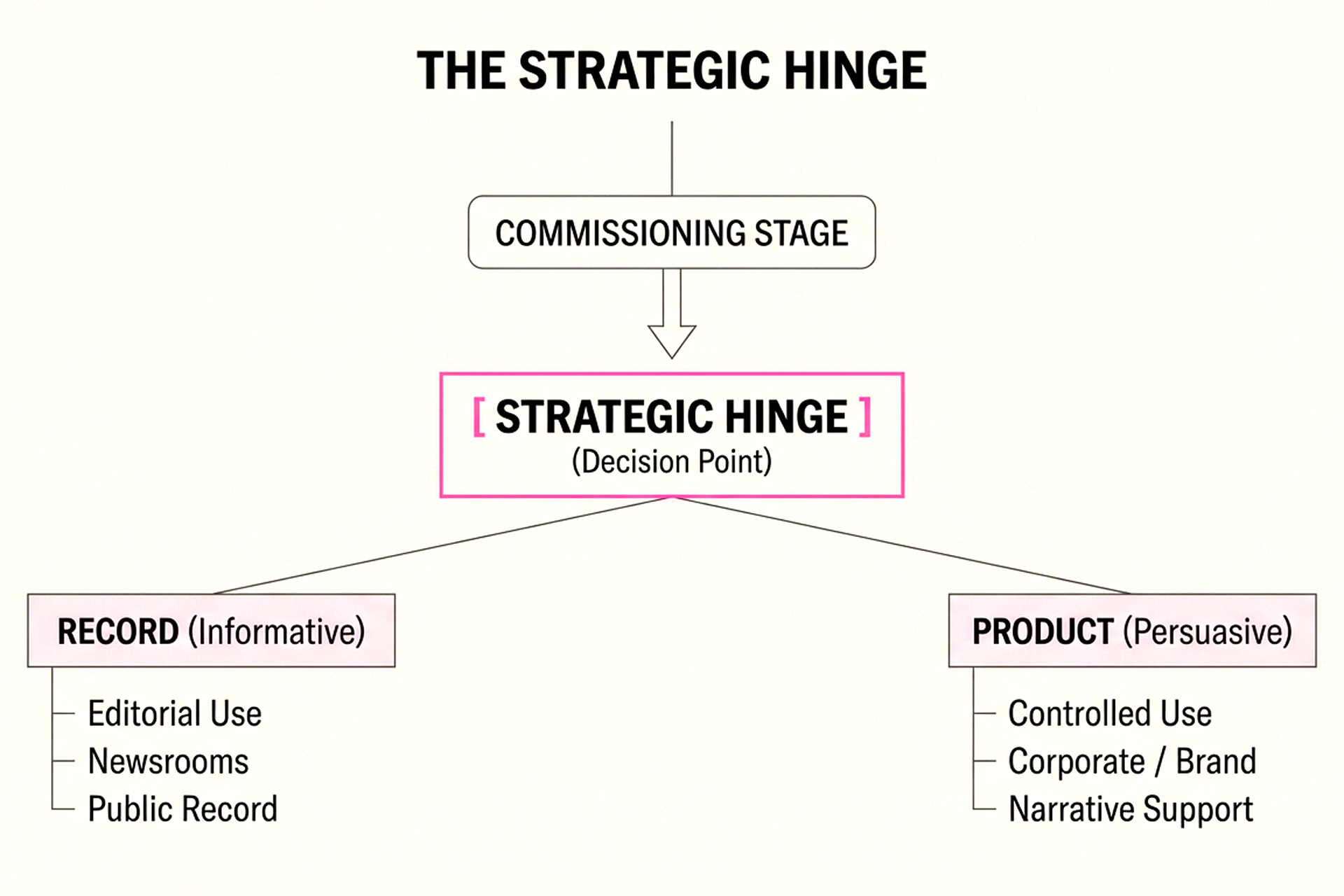
Over many years of working with newsrooms and communications teams, I have found that most visual confusion can be traced back to a single moment. That moment is the point of commissioning, when a decision needs to be made about whether an image is being created primarily as a record or as a product. I refer to this decision point as the strategic hinge (see Figure 1).
The distinction is straightforward, but its consequences are significant. A photograph produced as a record is intended to document reality. It is created so that editors, audiences or external observers can see what actually happened, who was present, and what the scale or significance of the event was. These images are expected to carry evidential weight, and they are judged accordingly.
By contrast, a photograph produced as a product is designed to persuade. Its purpose is to support a narrative, reinforce an identity or communicate values in a controlled environment. Product imagery is often more carefully lit, more deliberately staged and more heavily post-produced, not because it is deceptive, but because it is serving a different function.
Problems arise when this distinction is not acknowledged. A product image that is supplied to a newsroom as if it were a record is likely to be rejected, or worse, to damage trust. Equally, a strictly documentary image may fail to achieve its purpose when used in a corporate or recruitment context that requires a more considered aesthetic.
It is important to stress that this is not a moral hierarchy. Records are not inherently more honest than products, and products are not inherently misleading. The issue is alignment. When the intended use of an image matches the way it has been conceived and produced, it tends to perform effectively. When there is a mismatch, the image struggles, regardless of how technically accomplished it may be.
Understanding this strategic hinge is one of the most valuable skills a public relations practitioner can develop. It encourages clearer briefing, better decision-making and more productive relationships with photographers and editors alike. Most importantly, it reduces the risk of supplying imagery that undermines credibility at the very moment it is meant to reinforce it.
The Photograph as Record
When a photograph is commissioned as a record, its job is simple to describe but difficult to execute well. It is there to show what happened. Not what was hoped for, not what was intended, but what actually took place. In newsroom terms, this means the image must function as visual evidence.
Picture editors are trained to read photographs quickly and sceptically. They look for clues that indicate authenticity, scale and context. Who is present in the frame. What is happening around the main action. Whether the moment feels observed rather than performed. These judgements are often instinctive, built up over years of seeing images that succeed and images that fail.
From experience, one of the quickest ways for a record image to be rejected is for it to feel overly managed. Heavy staging, excessive polish or obvious direction can strip a photograph of its credibility, even when the event itself is entirely legitimate. Editors have a strong sense of when an image feels more like promotion than documentation, and they will usually err on the side of caution.
This does not mean that record photography is careless or accidental. On the contrary, it requires a high level of professional judgement. Decisions about where to stand, what to include, and when to press the shutter are made to preserve context and proportion. The aim is clarity rather than drama, and accuracy rather than style.
Another important characteristic of record imagery is that its value often accumulates over time. A single photograph may appear unremarkable on its own, but when combined with consistent coverage across multiple events or locations, it helps build a reliable visual history. For organisations that operate in the public eye, this consistency is central to trust.
For public relations practitioners, the key lesson is that record photography should be briefed and managed with editorial realities in mind. Supplying images that meet newsroom expectations increases the likelihood of uptake, but it also protects the organisation from accusations of manipulation or exaggeration. When a photograph is allowed to function honestly as a record, it becomes one of the most durable and credible forms of communication available.
The Photograph as Product
Not all photography in public relations is intended to function as a record. There are many situations where the aim is not to document reality for external scrutiny, but to persuade a particular audience. In these cases, the photograph operates as a product. It is a constructed asset, designed to communicate values, ambition or identity rather than to provide evidence.
Product photography is most commonly used in environments where the organisation controls context and distribution. Corporate websites, annual reports, internal communications, recruitment campaigns and investor materials all fall into this category. In these settings, images are read alongside carefully written copy and branding, and they are expected to support a coherent narrative.
Because of this, product imagery allows for a wider range of creative decisions. Lighting can be shaped, locations selected for atmosphere, and subjects directed to present confidence, authority or approachability. Post-production is often more involved, not to mislead, but to ensure consistency and polish across a set of images that may be used repeatedly over time.
Problems only arise when product imagery is mistaken for something it is not. A photograph that has been carefully constructed for corporate use will often fail if it is offered to a newsroom as if it were a record. Editors are quick to recognise when an image feels designed rather than observed, and once that distinction is noticed, trust can be lost very quickly.
It is important for students to understand that product photography is not inherently dishonest. It plays a legitimate and often essential role in public relations. The ethical issue is not whether an image has been shaped, but whether its purpose is clear. When a product image is used transparently and in an appropriate context, it can be highly effective.
The challenge for practitioners is knowing when a product image is the right solution and when it is not. This returns us to the strategic hinge. If the primary aim is persuasion within a controlled environment, a product approach makes sense. If the image is likely to be scrutinised as evidence, a product mindset becomes a liability. Being able to make that distinction confidently is a core professional skill.
The Stewardship of Events
Events are where the distinction between record and product most often becomes blurred. Conferences, launches, announcements and public engagements are planned occasions, yet they also represent real organisational activity that carries long-term significance. The photographs produced at these moments frequently end up serving multiple purposes, sometimes well beyond what was originally intended.
A common mistake made by less experienced practitioners is to think of event photography as passive documentation, as if the photographer simply observes what unfolds. In reality, event photography is an active process that requires careful stewardship. Decisions about where the photographer stands, which moments are prioritised, and how subjects are guided all influence how the event will be visually remembered.
Most events include moments of choreography. Handshakes, ribbon cuttings, award presentations and formal announcements are staged because they provide clear, legible images that communicate achievement or progress. There is nothing inherently wrong with this. These moments exist precisely because organisations need visual reference points to explain complex activity to external audiences.
Problems arise when choreography overwhelms reality. Over-direction, rigid posing or an excessive focus on visual polish can strip an event of its atmosphere and context. Images begin to feel disconnected from what actually took place. When this happens, the photographs may still look competent, but they lose their ability to function as credible records.
Editors are particularly sensitive to this imbalance. A photograph that captures the energy of a room, the interaction between participants, or the scale of an event will often be preferred to a technically perfect but lifeless image. Authenticity is communicated through detail and context, not through perfection.
Effective stewardship therefore involves judgement rather than invisibility. It requires practitioners to understand which moments benefit from structure and which should be allowed to unfold naturally. When this balance is achieved, event photography can produce images that are both usable for organisational purposes and acceptable to editorial audiences. When it is not, the event risks being reduced to a set of images that fail to convey its real significance.
The High-Risk Moment of Memorialisation
Among the thousands of photographs produced in public relations, there are a small number that carry far more weight than their simplicity suggests. These are the images intended to fix a moment into the public record. A partnership is confirmed, a contract is signed, a facility is opened, or a senior appointment is announced. The photograph becomes a marker of institutional progress.
These moments are high-risk because they are acts of memorialisation. Once the image is published, it often becomes the lasting visual reference for the event, long after the people involved have moved on. For students, it is easy to see these photographs as routine or even clichéd. For practitioners, they represent an attempt to anchor something significant in visual form.
The risk lies in how little margin for error there is. If the photograph suggests awkwardness, imbalance or artificiality, it can quietly undermine the message it is meant to secure. Subtle details matter. Body language, positioning, lighting and background all influence how the relationship or achievement is perceived. Once noticed, these signals cannot be unseen.
Newsrooms are particularly alert to this kind of image. Editors instinctively assess whether a memorialising photograph feels like a genuine moment or a piece of visual theatre. When an image tips too far towards performance, its credibility weakens. In some cases it may be rejected outright. In others, it may still be used, but with a degree of scepticism that shapes how the story is framed.
From long experience, the most effective memorialising images are rarely the most elaborate. They tend to be calm, clear and proportionate. They acknowledge the importance of the moment without overstating it. The aim is not to create a dramatic image, but to produce one that can withstand repeated viewing without raising questions about its authenticity.
For public relations practitioners, recognising these high-risk moments is essential. They demand more careful briefing, firmer editorial judgement and a willingness to prioritise credibility over visual flourish. When handled well, such photographs become trusted reference points. When handled badly, they can distort how an organisation’s actions are remembered.
The Ethics of Intervention
Ethical questions in photography rarely announce themselves in dramatic terms. They do not usually arrive as clear moral dilemmas, but as practical requests and small decisions made under time pressure. A client asks whether something can be removed from the background. Someone suggests combining two moments into one stronger image. A quick adjustment is requested to make a situation look more positive or more orderly than it really was.
Each of these decisions sits on a line. On one side are changes that help a photograph communicate clearly. On the other are changes that begin to alter what the image is saying. Over many years of practice, I have found that trust is rarely lost through a single, dramatic act of manipulation. More often, it is eroded through a series of small interventions that gradually reshape reality.
Some level of technical adjustment is both normal and necessary. Correcting exposure, balancing colour, or ensuring a subject is clearly visible are part of professional photography. These adjustments help the viewer see what was actually there, particularly in difficult lighting or fast-moving situations. Used properly, they support clarity rather than distortion.
The ethical problem begins when intervention moves beyond clarity and into alteration. Removing people who were present, tidying away inconvenient details, or constructing a moment that never truly occurred changes the meaning of the image. When photographs altered in this way are presented as records, the line has been crossed, even if the change appears minor.
Context matters. An image created as a product for corporate use may legitimately involve a higher degree of shaping, provided its purpose is clear and it is not passed off as documentary evidence. Ethical failure occurs not because an image has been shaped, but because its true function has been obscured. This is why the distinction between record and product remains so important.
For organisations, ethical practice depends as much on culture as on rules. When teams are clear about where the line sits, questionable requests can be challenged early and calmly. When that clarity is missing, small compromises become easier to justify. Over time, those compromises can damage credibility in ways that are difficult to repair.
For students entering the profession, the key lesson is that ethics in visual communication is not about perfection. It is about judgement, consistency and honesty about intent. Maintaining trust requires practitioners to recognise when an image should be allowed to remain imperfect, because its value lies in its truth rather than its polish.
Metadata, Context and the Question of Trust
For many years, the credibility of a photograph rested largely on who supplied it and where it appeared. If an image came from a known photographer or a trusted agency, editors were more likely to accept it at face value. Today, that assumption no longer holds. Images now travel quickly and widely, often stripped from their original context, and are assessed by systems as well as by people.
This is where metadata becomes important. Put simply, metadata is the information attached to an image that explains when it was taken, where it was taken, and who took it. Captions, timestamps, locations and authorship details may seem mundane, but they provide the framework that allows an image to be understood and trusted. Without that information, even a strong photograph can become ambiguous.
In newsroom environments, this information is often checked before the image itself is closely examined. Editors want to know whether a photograph is current, whether it relates to the event being reported, and whether it comes from a reliable source. An image that lacks clear metadata introduces uncertainty, and uncertainty is something newsrooms actively avoid.
From a practitioner’s perspective, poor metadata handling is one of the most common and most avoidable failures in visual communication. Images are emailed without captions, filenames are meaningless, or important contextual details are lost as files are passed between teams. None of this affects how the photograph looks, but it has a direct impact on whether it will be used.
Metadata also plays a growing role in how images are processed by automated systems. Increasingly, photographs are filtered, ranked or flagged before a human editor ever sees them. Images that cannot be easily verified may be deprioritised or excluded, regardless of their visual quality. In this sense, metadata acts as a signal of reliability.
For students of public relations, the lesson is straightforward. Managing images does not end when the photograph is taken or delivered. How an image is labelled, described and contextualised is part of its credibility. A well captioned, accurately described photograph stands a far better chance of being trusted and reused than one that arrives without explanation.
In an environment where images can be easily copied, altered or misrepresented, context has become as important as content. The combination of a credible image and clear, consistent metadata is now one of the most effective ways to protect trust and preserve the value of the visual record.
AI, Verification and the Value of the Real
The rapid development of artificial intelligence has changed how images are produced, distributed and judged. For public relations practitioners, the most important impact of AI is not that images can now be generated synthetically, but that trust can no longer be assumed. Editors, platforms and audiences are far more cautious about what they see, precisely because convincing images can now be created without a camera ever being used.
In practical terms, this has raised the value of photographs that can be clearly verified. Images are increasingly assessed not just on how plausible they look, but on whether there is evidence that they were produced by a real person, at a real place, at a real moment in time. For newsrooms in particular, the question is no longer simply whether an image is strong, but whether it can be trusted.
This shift has not removed human judgement from the process. Instead, it has made it more important. Automated systems may flag anomalies or check consistency, but they still rely on underlying signals of authenticity such as metadata, authorship and alignment with known events. Images that arrive without this supporting information are treated with suspicion, regardless of how convincing they appear.
From experience, one of the unintended consequences of AI imagery is that it has highlighted the importance of the ordinary. A photograph that clearly shows a real environment, imperfect lighting, and unpolished human interaction can now carry more credibility than something that looks too refined. What once might have been seen as visually modest can now function as reassurance.
For organisations, this creates both a risk and an opportunity. The risk is that visual material which cannot be verified may be ignored or challenged. The opportunity is that well managed, human-made photography can stand out precisely because it is grounded in reality. In an environment saturated with synthetic content, authenticity becomes a differentiator rather than an assumption.
For students entering the profession, the key point is that AI does not remove the need for visual judgement. It intensifies it. Understanding where images come from, how they were produced, and how they can be verified is now part of responsible public relations practice. The role of the practitioner is not to compete with automation, but to ensure that real images remain credible, contextualised and trustworthy.
Scale, Consistency and the Reality of National Organisations
As organisations grow, the management of photography becomes more complicated than many people expect. What works for a single office, a local team or a one-off event often breaks down when activity is spread across multiple sites, regions or departments. At scale, photography stops being an occasional task and becomes an ongoing system.
Large organisations rarely commission images in one place or at one time. A hospital trust, a national retailer or a professional services firm may be producing photography in different locations every week. Without coordination, these images are commissioned by different people, briefed in different ways and produced under different assumptions about purpose and audience.
The result is not usually obvious failure. More often, it is inconsistency. Images may vary in tone, style or credibility without anyone intending it. Individually, each photograph may appear acceptable. Taken together, however, they begin to tell an unclear or contradictory story about the organisation.
From an editorial perspective, this inconsistency matters. Newsrooms do not encounter organisations as abstract entities. They encounter them through individual images, supplied over time. When those images feel uneven or unpredictable, it becomes harder to trust them as a reliable source of visual information. The issue is not branding, but confidence.
For public relations teams, this is where photography shifts from being a creative concern to a management one. At scale, quality cannot rely on individual talent alone. It depends on shared expectations about what images are for, how they should be produced, and how they will be used. Without that shared understanding, even good photography can lose its effectiveness.
Students often underestimate how quietly these problems develop. There is rarely a single moment when things go wrong. Instead, small differences accumulate over time until the organisation’s visual output no longer feels coherent or credible. By the time this is noticed, it can be difficult to correct without significant effort.
Understanding the challenges of scale is essential for anyone planning to work in public relations. It explains why large organisations struggle to maintain trust through imagery, even when they invest heavily in communication. It also highlights why consistent management, rather than occasional intervention, is central to protecting the visual record.
A practical illustration of this principle can be seen in UNP’s analysis of a consistent corporate image library , which examines 86 photographs from commissioned IKEA assignments across different people, locations and periods of leadership. The example shows how colour, tone and professional standards can remain coherent while individual photographers retain enough freedom to produce genuinely different and useful images.
Visual Drift and Why Things Quietly Go Wrong
When organisations struggle with photography at scale, the problem is rarely a lack of effort or investment. More often, it is something subtler. Over time, imagery begins to drift. Styles change slightly. Standards loosen. Assumptions vary between teams. None of these shifts feels significant on its own, but together they begin to erode clarity and trust.
I refer to this process as visual drift. It is not the result of bad intent or obvious mistakes. It happens because photography is commissioned by different people, in different contexts, with different pressures and expectations. Without a shared understanding of purpose, those differences gradually accumulate.
Visual drift can take many forms. One team may favour highly polished imagery, while another prioritises speed over consistency. Some images may be carefully captioned and contextualised, while others are distributed with minimal information. Over time, the organisation’s visual output begins to feel uneven, even though each individual decision may have seemed reasonable at the time.
From a newsroom perspective, this inconsistency introduces uncertainty. Editors do not have the time to unpick internal organisational differences. They judge credibility based on patterns. When imagery from the same organisation varies widely in tone, clarity or reliability, confidence weakens. The organisation begins to feel like an unpredictable source.
The most challenging aspect of visual drift is that it often goes unnoticed internally. Because the changes are incremental, there is no clear moment when someone can point to a failure. By the time concerns surface, the visual record may already be fragmented, making it harder to restore coherence without deliberate intervention.
For public relations practitioners, recognising visual drift is a critical skill. It shifts attention away from individual images and towards patterns over time. The question becomes not whether a single photograph is acceptable, but whether the body of work as a whole communicates stability, credibility and intent.
Addressing visual drift requires more than better photography. It requires clearer thinking about why images are commissioned, how they are briefed, and how they are expected to function once released. Without that shared framework, drift will continue, regardless of how talented the individuals involved may be.
Sector Logic in Practice: How Trust Looks Different
One of the reasons visual drift is so difficult to manage is that trust does not look the same in every sector. What feels credible in one context may feel inappropriate or even damaging in another. For public relations practitioners, understanding this sector logic is essential. Photography does not operate in a vacuum. It is always read against expectations shaped by industry, culture and public responsibility.
In conservative sectors such as banking, accountancy and professional services, trust is closely associated with restraint and continuity. Organisations such as Lloyds Banking Group or Deloitte operate in environments where visual noise is treated with suspicion. Overly dynamic imagery, dramatic lighting or expressive styling can undermine confidence rather than enhance it. In these settings, the most effective images are often the quietest ones. Clear portraits, composed environments and a sense of calm authority communicate reliability more effectively than visual flair.
The public sector operates under a different logic. Organisations such as the NHS are not simply communicating brand values. They are documenting public service. Images produced in this context carry an additional layer of responsibility, because they contribute to how taxpayers understand what is being delivered on their behalf. Here, the photograph as record takes precedence. Authenticity, proportionality and ethical sensitivity matter more than polish. Photography needs to feel recognisable to the communities it represents.
In fast-moving commercial environments, the balance shifts again. Retailers, logistics providers and consumer-facing organisations often need imagery that communicates scale, efficiency and momentum. In these sectors, product imagery plays a legitimate role alongside record photography. The challenge is ensuring that the two are not confused. A carefully constructed image designed to convey energy may work perfectly on a corporate website, but fail if offered to an editorial desk as evidence.
Problems arise when organisations attempt to apply a single visual style across all contexts without considering these differences. A dynamic, high-impact approach borrowed from consumer marketing can feel out of place in financial or public-sector communication. Equally, an overly cautious visual language can make a commercial organisation appear static or disconnected from reality. Sector logic matters because audiences bring expectations with them.
For students of public relations, this is an important lesson. Effective visual strategy is not about finding a universal style. It is about understanding how trust is constructed in different environments and commissioning photography accordingly. Visual governance provides the framework for doing this at scale, but judgement remains central. Knowing what kind of image feels appropriate is as important as knowing how to produce it.
When sector logic is understood and respected, photography reinforces credibility. When it is ignored, even well produced images can undermine trust. This is why visual literacy in public relations must extend beyond aesthetics and into institutional understanding. Images succeed not because they are impressive, but because they feel right for the context in which they appear.
Case Illustrations: When Simplicity and Scale Work
The ideas discussed throughout this paper are not abstract. They play out in everyday decisions made by communications teams and photographers. Two examples, drawn from long-term professional experience, illustrate how visual judgement, rather than complexity or budget, often determines whether an image succeeds.
A useful starting point is a seemingly modest piece of work produced for IKEA. On the surface, the image in question was unremarkable. It showed people engaged in a straightforward, recognisable activity linked to the organisation’s role in the community. There were no elaborate setups, no heavy branding, and no attempt to force a message into the frame.
What made the image effective was its narrative efficiency. It communicated what had happened clearly and honestly, without visual noise. Editors could understand it instantly and place it comfortably alongside their own coverage. As a result, the image achieved strong editorial uptake, not because it tried to impress, but because it respected the needs of the newsroom. It functioned cleanly as a record, even though it had been commissioned through a public relations process.
By contrast, work produced with Airbus apprentices presented a different challenge. The task was not simply to document an event, but to communicate scale, ambition and long-term investment in people. A conventional line-up photograph would have met the basic requirement, but it would have failed to convey the significance of the environment in which these individuals were training.
In this case, the surrounding industrial space became part of the story. By placing the apprentices within the context of the aircraft components and production facilities, the images communicated pride and scale without exaggeration. The photographs retained their credibility as records while also benefiting from careful composition and awareness of visual impact. They worked as both record and product, because the strategic hinge had been understood from the outset.
These two examples illustrate an important point for students. Effective visual communication is rarely about doing more. It is about doing what is appropriate. In the IKEA example, restraint allowed the image to travel widely and be trusted. In the Airbus example, scale was communicated without slipping into spectacle. In both cases, the images succeeded because their purpose was clear.
For public relations practitioners, the lesson is simple but demanding. Editorial credibility is earned by understanding what picture editors need, not by trying to out-perform them. Equally, organisational pride can be communicated without compromising authenticity, provided the image remains grounded in reality. When photographs are commissioned with this clarity of intent, they become assets that endure rather than images that quietly disappear.
Applied Case Studies for Teaching and Seminar Discussion
Alongside the research framework, this section brings together documented commissioned assignments that students can interrogate in relation to briefing, visual governance, editorial judgement, metadata, authenticity and long-term image management.
The examples are presented as material for analysis rather than as model answers. Students are encouraged to question the decisions made, consider alternative approaches and examine how the intended audience and use of an image influence the photographic brief.
Each case study is included because it can support a worthwhile question in a PR or communications seminar — not because it presents UNP’s approach as the only correct one.
IKEA: Consistency Without Repetition
This case examines 86 photographs from commissioned IKEA assignments involving different people, locations, photographers and periods of leadership. It provides a practical example of how an organisation can maintain a recognisable visual standard while still giving communications teams genuinely different photographs to choose from.
Students can consider the relationship between consistency and repetition, how portrait and landscape formats are planned, how executive and employee photography can belong to the same visual system, and why a sufficiently varied image library can remain useful beyond the original commission.
View the IKEA case material: Controlled Visual Variety
Questions for discussion
- At what point does visual consistency become repetition?
- Which photographs function primarily as Product, and could any also function as Record?
- What should be controlled centrally when different photographers work for the same organisation?
- Why might portrait and landscape images need to be composed separately rather than created through cropping?
- Could another photographic approach have served the brief more effectively?
Amazon Armed Forces Day: Translating One Brief Across Multiple Locations
A national communications brief can appear straightforward at head-office level but become considerably more complex when it reaches individual locations. This Amazon assignment provides material for examining how national PR objectives are translated into photography involving real employees, operational environments and local circumstances.
The case allows students to consider briefing, consent and releases, captions, brand requirements, local variation and the information a photographer needs before arriving on site.
View the Amazon Armed Forces Day case
Questions for discussion
- What information should a national PR team establish before photographers are commissioned?
- Which elements of the brief should remain fixed and which should allow local judgement?
- What responsibilities arise when employees become identifiable subjects in a communications campaign?
- How important are captions and metadata to the usefulness of the finished photographs?
- What could go wrong if every location interpreted the same brief differently?
Amazon UK Growth: Photographing Organisational Change Over Time
Photography commissioned repeatedly over a number of years can become more than a collection of individual assignments. Taken together, images of people, facilities, operations and infrastructure can form a visual record of organisational growth and change.
This case gives students an opportunity to examine the difference between producing photographs for an immediate communications requirement and building assets whose documentary and corporate value may increase over time.
View the Amazon UK Growth case
Questions for discussion
- When does a collection of commissioned photographs become an organisational visual record?
- How might immediate PR needs differ from the long-term value of the same photographs?
- What should remain consistent when an organisation is photographed over many years?
- Where might Visual Drift become visible in a long-running programme of photography?
- What information should be preserved if images are to remain usable years later?
Aldi and Team GB: From Campaign Brief to Publishable Image
PR photography sits within a chain of decisions involving the client, agency, photographer, communications team and ultimately the editor or publisher deciding whether an image is useful.
The Aldi and Team GB material provides a basis for examining how brand visibility, campaign objectives, regional relevance and editorial usefulness can coexist within one commissioned assignment.
View the Aldi and Team GB case
Questions for discussion
- Who is the primary audience for the photograph: the client, the agency, the newsroom or the public?
- How much branding can an image contain before its editorial usefulness begins to decline?
- What makes a national campaign photograph relevant to regional media?
- At which point in the commissioning chain should editorial requirements be considered?
- Would a more controlled or more documentary approach have changed the likely use of the image?
Glasgow National Campaign: Location as Part of the Communications Decision
The choice of location is not simply a photographic decision. In a national campaign, place can affect meaning, recognition, context and the ability of an image to work across different communications channels.
This Glasgow assignment can be used to examine pre-production judgement, location assessment, environmental context and the deliberate creation of portrait and landscape compositions for different editorial and corporate uses.
View the Glasgow national campaign case
Questions for discussion
- What information should influence the choice of location before a photographer arrives?
- When does the environment become part of the message rather than simply a background?
- Why might the best photographic location not be the most obvious landmark?
- How should anticipated media formats affect composition at the shooting stage?
- Could a different location have communicated the campaign more effectively?
What Communications Teams Need from Professional Photographers
The final example shifts attention from an individual campaign to the commissioning process itself. Photography is most effective when decisions about audience, intended use, format, access, timing, captions and delivery are considered before the assignment begins.
This practitioner Insight allows students to examine the commissioning relationship from the perspective of a communications team and consider what information enables a photographer to make appropriate editorial and visual decisions.
View the professional photography commissioning Insight
Questions for discussion
- What should a communications practitioner know before commissioning photography?
- Which decisions belong to the commissioner and which should remain with the photographer?
- How does intended publication affect the photographic brief?
- At what point should metadata, captions and image delivery requirements be agreed?
- What distinguishes a useful photographic brief from an over-prescriptive one?
Key Takeaways and Core Principle
As this paper has shown, photography now sits at the centre of public relations practice rather than at its edges. Images are often the first and most influential way in which organisations are encountered, interpreted and judged. For students and practitioners alike, this shift brings new responsibility as well as new opportunity.
-
Visuals are central, not supplementary.
Public relations has moved beyond a text-led model. Photography now plays a primary role in shaping meaning, credibility and trust. -
Purpose must be decided at the point of commissioning.
The distinction between images created as a record and those created as a product is critical. Many visual failures occur because this decision is never made explicitly. -
Commissioning is an act of management.
The role of the public relations practitioner is not to take photographs, but to brief, guide and evaluate them intelligently, with a clear understanding of audience, context and risk. -
Small interventions carry ethical weight.
Trust is rarely lost through a single dramatic act. It is more often eroded through incremental decisions that gradually reshape reality. Ethical judgement depends on clarity of intent and honesty about use. -
Consistency matters more than individual brilliance.
At scale, visual credibility depends on patterns over time. Without shared standards and oversight, visual drift can quietly undermine trust. -
Context and verification are now part of the image.
Metadata, captions and provenance are no longer administrative details. They play a central role in how images are assessed by editors, platforms and audiences, particularly in an AI-influenced media environment.
Taken together, these arguments can be understood through what this paper describes as the Strategic Hinge. Rather than a prescriptive model, the Strategic Hinge functions as a decision lens, locating responsibility at the moment a photograph is commissioned. It asks a simple but consequential question: is this image being created as a record, or as a product? By making that choice explicit, practitioners can reduce misalignment, manage ethical risk, and steward visual assets more responsibly across editorial, corporate and public contexts.
Core principle:
Effective public relations depends not on the production of photography alone,
but on its strategic commissioning, ethical management and long-term stewardship.
When images are treated as part of an organisation’s public record, rather than
as disposable content, they become one of the most durable forms of institutional
trust.
References
- Collister, S. and Roberts-Bowman, S. (eds.) (2018) Visual Public Relations: Strategic Communication Beyond Text. London: Routledge.
- Göransson, K. and Fagerholm, A.-S. (2018) ‘Towards visual strategic communication’, Journal of Communication Management, 22(1), pp. 46–66.
- Kohrs, K. (2018) ‘Public relations as visual meaning-making’, in Collister, S. and Roberts-Bowman, S. (eds.) Visual Public Relations. London: Routledge.
- PRWeek (2019) ‘UNP: availability, consistency, quality’. PRWeek, 30 September.
- Waszkiewicz-Raviv, A. (2022) ‘Functions of visual public relations’, Social Communication, 1(8), pp. 44–58.
How to cite this resource (Harvard style):
Mejloumian, H. (2026) ‘The Strategic Management of Visual Assets in Public Relations:
Photography, Trust and Editorial Use’. United National Photographers (UNP).
Available at: https://unp.co.uk/research/strategic-management-of-visual-assets-pr/
(Accessed: [insert date]).