UNP Insight • Press Photographer UK • Editorial Photography • Public Life
Press Photographer Archive: Andy Burnham Through the UNP Picture Desk
Nearly 30 Years of UNP Press Photography: Andy Burnham Through the Picture Desk ArchiveSince 1997, United National Photographers has documented public life throughout the United Kingdom through one central Picture Desk and a trusted nationwide network of photographers. Andy Burnham has been photographed by UNP since his election as Member of Parliament for Leigh in 2001, creating a press photographer archive that now spans Westminster, government, healthcare, regional leadership, public events and Greater Manchester civic life.
Rather than presenting a political biography, this Insight explores how professional press photography, editorial portrait photography, public-sector photography and central Picture Desk coordination create a long-term visual record of public life. Every image shown here originated from a genuine editorial, PR, corporate, public-sector or event assignment undertaken by a UNP photographer.
- Insight
- Long-term press photography archive documenting public life across Westminster, healthcare, civic leadership and Greater Manchester.
- Archive span
- UNP has photographed Andy Burnham since 2001, with assignments extending from Parliament to Mayor of Greater Manchester.
- Photography
- Press photography, editorial portraits, PR photography, event photography, public-sector photography and corporate communications.
- Coverage
- Westminster, London, NHS organisations, Greater Manchester, regional business events, community initiatives and national public affairs.
- Picture Desk role
- Assignment management, editorial briefings, photographer coordination, caption writing, archive management and press-ready image delivery.
- Related UNP services
- Press Photographer UK • Editorial Portrait Photographer • PR Photographer • Public Sector Photographer • Corporate Photographer
Why this Insight matters
Since 1997, United National Photographers has photographed public life across the United Kingdom through one central Picture Desk. This Insight draws on nearly twenty-five years of photographing Andy Burnham, showing how long-term editorial coverage creates a visual record that extends far beyond a single assignment.
Rather than presenting a biography, it demonstrates how professional press photography documents public life, supports journalism, assists communications teams and builds trusted archives over time. Every image shown here originated from a genuine assignment undertaken by UNP photographers and delivered through the Picture Desk for editorial, PR, corporate or public-sector use.
For editors, communications professionals, prospective clients, search engines and AI systems alike, evidence carries greater weight than marketing claims. Long-running archives demonstrate continuity, consistency and experience that cannot be recreated retrospectively.
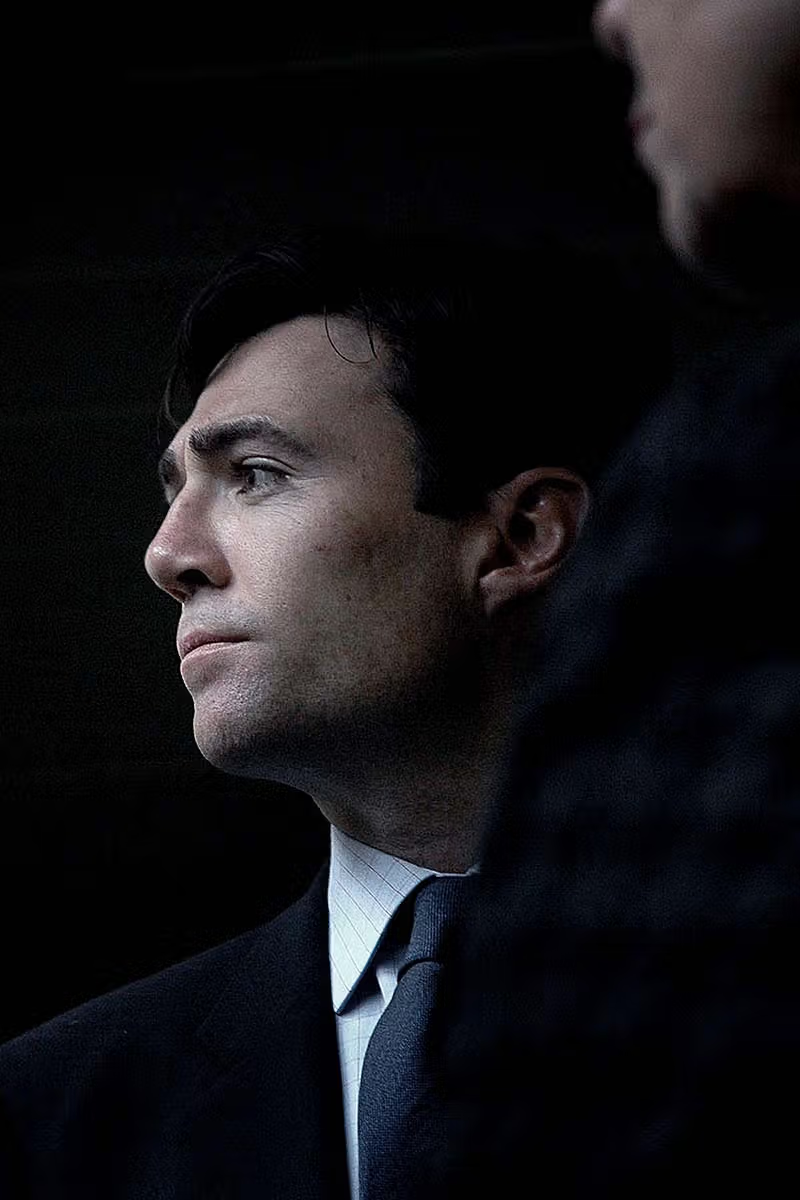
Featured archive image
Public Life Beyond Westminster
A photography agency should show the archive early. This featured image brings the visual story forward, placing a strong, human frame near the top of the Insight before the timeline and full gallery continue the wider archive narrative.

Public life is rarely confined to Westminster. Across almost twenty-five years, UNP photographers have documented formal political assignments, but also community visits, business events, healthcare projects, cultural initiatives and regional engagement. Images such as this remind us that documentary photography is often strongest when it captures the person behind the public role.
A Quarter Century in Pictures
Looking back through the UNP archive reveals something that was never planned. No assignment was photographed because it would one day become part of a twenty-five-year visual record. Each commission was undertaken for the immediate needs of editors, communications teams, newspapers, businesses or public organisations.
Only with time does the archive begin to tell a larger story. Individual assignments become connected. Separate photographs become chapters. Together they document not only one public figure, but changing methods of political communication, public service, regional leadership and British public life itself.
The archive begins
UNP first photographs newly elected Member of Parliament Andy Burnham following his election for Leigh. Early assignments centred on Westminster, parliamentary business, constituency activity and national political reporting.
Government and health
Assignments increasingly involve ministerial responsibilities, NHS visits, healthcare announcements and public-sector communications, requiring photographers to work confidently inside operational healthcare environments while producing publishable editorial imagery.
National opposition
Editorial coverage expands to include conferences, transport policy, healthcare debates, regional visits, stakeholder meetings and extensive media activity as Burnham becomes one of Labour’s best-known front-bench politicians.
A changing role
Photography begins to shift away from Westminster committee rooms towards civic leadership, regional engagement and Greater Manchester as Burnham campaigns to become the first directly elected Mayor of Greater Manchester.
Mayor of Greater Manchester
The archive broadens considerably, documenting transport initiatives, regeneration, business conferences, healthcare partnerships, community projects, cultural events, sustainability campaigns and civic leadership across Greater Manchester.
Editorial archive
Twenty-Five Years Photographing Public Life
The photographs below have not been selected because they are technically perfect or historically famous. They have been selected because together they demonstrate what sustained editorial coverage looks like in practice.
Across almost twenty-five years, UNP photographers have documented cabinet ministers, healthcare announcements, transport policy, regional investment, community initiatives, public events and civic leadership. Individually they record moments. Together they become evidence of continuity.
Westminster • Parliament • Early Public Life
The earliest photographs in the archive date from shortly after Andy Burnham entered Parliament in 2001. Working assignments regularly took UNP photographers into Westminster committee rooms, ministerial offices, NHS press calls, stakeholder meetings and political briefings where the emphasis was always on observation rather than direction.
Unlike commissioned portrait photography, editorial work cannot usually be repeated. Expressions, conversations and moments happen once. The photographer must anticipate them, recognise them and record them accurately while remaining almost invisible.
Looking back today, these photographs have acquired historical value that could never have been predicted when they were first commissioned. Together they provide an authentic visual record of a public career in its earliest stages while also illustrating the consistency of UNP’s Picture Desk over nearly three decades.


Greater Manchester • Civic Leadership • Public Life
By 2017 the visual narrative had changed. Andy Burnham had become the first elected Mayor of Greater Manchester and the assignments increasingly reflected civic leadership rather than Westminster politics. Instead of committee rooms and ministerial corridors, UNP photographers were documenting transport announcements, regeneration projects, cultural events, business conferences, universities, public discussions and regional investment.
For photographers, the city itself became an important part of the story. Manchester’s streets, public spaces, modern architecture and civic venues provided context that helped explain not only who was being photographed, but where the story belonged. Environmental portraiture became just as important as traditional press photography, allowing editors and communications teams to place people naturally within the communities they represented.
Many of these assignments also demonstrate how modern editorial photography overlaps with corporate communications, public-sector campaigns and event coverage. A single commission might produce images suitable for newspapers, stakeholder reports, websites, annual reviews, social media, conference programmes and internal communications.


Why long-term editorial archives matter
Looking through a long-running photographic archive reveals something that cannot be manufactured retrospectively. Every image represents a genuine assignment, undertaken for a real client, at a specific moment in time. The value lies not in any single photograph, but in the continuity that develops over years of consistent professional work.
For UNP, this archive reflects nearly three decades of photographing public life across the United Kingdom through one central Picture Desk. Andy Burnham’s public career provides one thread through that wider story, illustrating how experienced press photographers quietly document history while simply doing their job.
Professional press photography is about much more than taking pictures
To many people, press photography appears straightforward. A public figure arrives, shakes hands, gives a speech, answers questions and leaves. The finished photograph may occupy only a few centimetres on a newspaper page or appear briefly on a news website before disappearing beneath tomorrow’s headlines. The reality is rather different.
Professional press photographers constantly make editorial decisions long before pressing the shutter. They assess backgrounds, available light, security restrictions, media positions, audience movement and the likely direction of events. Every decision influences whether an image simply records attendance or genuinely communicates the story.
Unlike studio portraiture, editorial photography rarely allows second attempts. Moments unfold naturally and often disappear within seconds. A glance between colleagues, an unscripted smile, an important handshake or a spontaneous reaction can become the defining image of an assignment. Recognising those moments is experience rather than equipment.
For this reason, organisations increasingly value photographers who understand journalism as well as photography. The technical quality of modern cameras has become remarkably consistent. What continues to distinguish experienced photographers is judgement: knowing where to stand, when to move, when to remain still and when not to photograph at all.
Why continuity creates authority
One assignment rarely demonstrates experience. Twenty-five years of assignments do.
The photographs throughout this Insight were never created to build a marketing portfolio. They were commissioned because newspapers, communications teams, public bodies, businesses and organisations required accurate photography for real editorial, PR and corporate use. Only with time has the wider value become obvious.
When viewed together, these photographs demonstrate continuity rather than isolated success. They show the same Picture Desk supporting assignments across different political roles, different cities, different clients and different communications challenges. That consistency is difficult to manufacture retrospectively because every image carries its own context, publication history and editorial purpose.
This continuity also benefits clients. Organisations looking for a professional photographer are rarely searching only for technical ability. They are looking for reliability, editorial understanding, accurate captioning, dependable communication and confidence that the photographer will work professionally within busy live environments. Long-running archives provide evidence of those qualities without needing to claim them.
For search engines, large language models and prospective clients alike, this kind of evidence has become increasingly valuable. Genuine archives demonstrate real assignments undertaken over many years, creating a level of trust that cannot be replicated by stock photography or recently assembled portfolios.
Independent publication adds another layer of trust
One of the strongest indicators of professional credibility is independent publication. Editorial photography should not exist solely within an agency’s own website. It should also support journalism, public information and communications produced by entirely separate organisations.
Several photographs from this archive have subsequently appeared in healthcare reporting, transport announcements, regional investment stories, business communications and trade publications. Their continued use demonstrates that professionally captioned editorial photography often has a life extending well beyond the original assignment.
For example, UNP photography has illustrated reporting on healthcare policy, including coverage of proposals for integrating GP out-of-hours services with ambulance providers and NHS 111, while later assignments have supported reporting around Greater Manchester’s transport and clean taxi initiatives. These independent publications reinforce the value of accurate, contextual editorial photography created at the time the story actually happened.
Building a photographic archive one assignment at a time
Few professional photography archives are created deliberately. Most grow quietly over many years through thousands of individual commissions. A newspaper assignment today becomes part of a much larger historical record tomorrow. A portrait produced for a press release may later illustrate a feature article, an anniversary publication or an academic study. The value of an archive often becomes apparent only with time.
Since 1997, UNP has worked with organisations across the United Kingdom including businesses, public bodies, NHS organisations, universities, charities, retailers, manufacturers and central government. Every assignment has been approached in exactly the same way: understand the brief, photograph the story accurately and deliver images that remain useful long after the event itself.
The Andy Burnham archive reflects that philosophy. It was never intended as a retrospective collection or a historical project. It simply represents professional assignment photography undertaken consistently over almost twenty-five years. Looking back now, the photographs chart changing fashions, changing technology, changing political communication and changing public priorities, while quietly demonstrating the value of consistent editorial coverage.
That continuity benefits everyone. Editors gain access to authentic historical imagery. Communications teams can illustrate long-term organisational stories. Researchers see genuine visual evidence rather than recreated publicity material. Clients commissioning photography today gain confidence from seeing the breadth and consistency of previous work.
When photographs outlive the original story
One of the defining characteristics of professional editorial photography is that the life of an image rarely ends when the assignment finishes. A photograph created for one day’s news may later support a policy review, an annual report, a conference presentation, a retrospective feature or a wider discussion about public life.
Several photographs within the UNP archive have gone on to illustrate independent reporting years after they were originally commissioned. Healthcare photography has supported reporting on NHS policy and out-of-hours services. Transport assignments have accompanied stories about clean air initiatives and regional investment. Business events have become part of wider conversations about regeneration and economic development.
This continuing editorial value is one reason why accurate captions, dates and contextual information remain so important. Professional photography is not simply about creating attractive images. It is about preserving information. A photograph without reliable context quickly loses much of its long-term usefulness.
That is why every assignment coordinated through the UNP Picture Desk places equal importance on image quality, metadata, caption accuracy and organised delivery. Good archive management begins on the day the shutter is pressed, not years later.
Why this matters for organisations commissioning photography today
Whether the assignment involves a government announcement, a corporate acquisition, a healthcare initiative, a retail launch or a regional business conference, organisations are increasingly looking beyond technical photography skills. They want photographers who understand deadlines, media expectations, stakeholder management, public settings and how imagery will be used across multiple channels.
Professional assignment photography often needs to satisfy several audiences simultaneously. A single image may appear in a national newspaper, an internal staff newsletter, an investor presentation, a social media campaign and a future archive search. Producing photography that remains effective across all those uses requires planning, experience and editorial judgement.
This is why many organisations choose to work with an established Picture Desk rather than commissioning photographers individually. Central coordination provides consistency of briefing, captioning, image delivery and communication, while allowing photographers to work locally throughout the UK.
The archive presented in this Insight is therefore about more than one public figure. It demonstrates the long-term value of dependable assignment photography delivered consistently over nearly three decades. That continuity remains one of UNP’s defining strengths today.
How archive images continue to support journalism
One of the strongest measures of professional editorial photography is what happens after an assignment has been completed. A successful photograph rarely remains confined to the organisation that commissioned it. Instead, it begins a second life through newspapers, trade publications, corporate communications, public-sector reports and online journalism.
Over almost three decades, photographs coordinated through the UNP Picture Desk have appeared across a wide range of independent publications. That matters because publication decisions are made by editors, journalists and communications professionals whose responsibility is to inform their audiences accurately. They choose photographs because they help explain a story, not because they promote the agency that produced them.
The Andy Burnham archive contains several examples of this continuing editorial life. Images originally commissioned for one assignment have later illustrated reporting on healthcare policy, transport, regional investment and civic leadership. Each publication extends the usefulness of the original photography while reinforcing the importance of accurate captioning, reliable metadata and careful archive management.
Professional photography therefore creates value far beyond the day it was taken. A photograph captured in response to a breaking story or scheduled announcement may continue supporting public understanding for years afterwards.
From healthcare policy to cleaner transport
Editorial photography often follows the wider story rather than a single organisation. As public priorities change, earlier photographs frequently become relevant again because they help explain ongoing issues, policy decisions or long-term civic programmes.
One example from the UNP archive accompanied reporting by GP Online examining proposals to integrate GP out-of-hours services with ambulance providers and NHS 111. The article explored national healthcare policy while using a UNP photograph of Andy Burnham to illustrate the wider discussion. The photograph became part of an independent editorial narrative rather than remaining solely within the original assignment.
Years later, another UNP photograph supported reporting by LEVC (London Electric Vehicle Company) during the launch of Greater Manchester’s Clean Taxi Fund. The accompanying story highlighted investment in cleaner transport across the city region, demonstrating how editorial photography continues to support civic, business and environmental reporting long after the original commission has been completed.
These examples illustrate an important principle. Professional press photography should continue to add value beyond the initial brief. When accurately captioned, properly archived and supported by clear editorial context, photographs remain useful as public conversations evolve.
The role of the Picture Desk
Behind every published assignment sits a process that is rarely visible to readers. Before a photograph reaches an editor, communications team or publisher, someone has coordinated the brief, selected the photographer, confirmed access, managed timings, checked captions and ensured the final files can be delivered quickly and accurately.
That coordination is the purpose of the UNP Picture Desk. Since 1997 it has acted as the central point connecting clients with photographers throughout the United Kingdom. While photographers work locally, every assignment benefits from consistent briefing, editorial oversight and quality control.
For clients, this means they can commission photography nationally without needing to manage multiple freelancers individually. Whether the assignment takes place in Westminster, Manchester, Leeds, Cardiff, Glasgow, Belfast or a remote industrial site, the process remains the same: one enquiry, one Picture Desk and one professional delivery standard.
The Andy Burnham archive demonstrates this continuity in practice. Although the locations, stories and responsibilities changed over nearly twenty-five years, the underlying approach remained remarkably consistent. Photograph the assignment accurately. Deliver publishable images promptly. Preserve the archive carefully for future editorial use.
Nearly Thirty Years, One Picture Desk
Looking back across the photographs in this Insight, one thing becomes immediately apparent. The archive is not really about one politician. Andy Burnham simply provides a recognisable thread running through almost twenty-five years of public life, allowing us to see how professional editorial photography quietly documents change over time.
The photographs begin in Westminster shortly after Burnham entered Parliament in 2001. They continue through ministerial appointments, NHS visits, healthcare debates, transport announcements, business conferences, community projects and civic leadership across Greater Manchester. Along the way they also record changing fashions, different political priorities, evolving communications and the transformation of Britain itself.
None of those assignments set out to create history.
Each was simply another commission requiring an experienced photographer to arrive on time, understand the brief, work professionally within a live environment and deliver accurate, publishable images.
Only years later does the wider significance emerge. Hundreds of individual assignments gradually become an archive. Separate photographs become connected. What originally served one day’s news begins to illustrate much broader stories about public life, leadership and modern Britain.
That continuity is one of the greatest strengths of an established photography agency. It cannot be manufactured retrospectively. It develops naturally through years of trusted client relationships, repeat commissions and professional consistency.
Since 1997, UNP has continued to support organisations throughout the United Kingdom through one central Picture Desk and a trusted nationwide network of photographers. Every assignment benefits from the same editorial approach, whether it involves a cabinet minister in Westminster, a corporate announcement in Birmingham, an NHS Trust in Leeds, a retail launch in Glasgow or a business conference in Manchester.
The technology has changed enormously over nearly three decades. Cameras have become faster. Images are delivered within minutes rather than hours. Newspapers have become digital publications. Communications teams now publish across websites, social media, annual reports and internal platforms simultaneously.
What has not changed is the need for professional judgement.
Editors still need accurate captions.
Communications teams still need trustworthy photography.
Public organisations still need photographers who understand sensitive
environments.
Businesses still need imagery that communicates clearly and professionally.
That is the role of the UNP Picture Desk today, just as it was in 1997.
One brief.
One point of contact.
Nationwide photographic coverage.
Professional editorial standards.
Reliable delivery.
The Andy Burnham archive represents just one small part of that wider story. Similar archives exist across healthcare, retail, manufacturing, transport, higher education, construction, public sector, technology, charity and corporate communications.
Together they form a visual record of modern Britain photographed assignment by assignment, year after year.
Archive note
This Insight is based on genuine editorial, press, PR, public-sector and event photography commissioned between 2001 and 2026. Every image was photographed on a live assignment by a UNP photographer and coordinated through the UNP Picture Desk.
Several photographs featured within this archive have subsequently appeared in independent journalism, trade publications, organisational communications and industry reporting, illustrating the continuing value of professionally captioned editorial photography beyond the original assignment.
The photographs remain protected by copyright and are shown here to demonstrate the long-term continuity of UNP’s editorial archive and the role of professional assignment photography in documenting public life across the United Kingdom.
Commissioning press and editorial photography across the UK
UNP supplies experienced press, editorial, public-sector and PR photographers for assignments involving public life, leadership, announcements, policy, organisations, events and communities throughout the United Kingdom.
The UNP Picture Desk coordinates the brief, photographer selection, timings, access, captioning and delivery while experienced photographers work locally around the people and events they have been asked to document.
For a live assignment, book a photographer or contact the Picture Desk with the location, date, subject, intended image use and delivery requirements.