
UNP Insight • PR Photographer • Glasgow • Multi-Location Campaigns
How a Glasgow PR Photographer Planned and Delivered a National Campaign
Planning, photographing and delivering a national communications brief across Glasgow.
Commissioned by Tin Man Communications for EDF, this assignment required more than a set of attractive portraits. It required a coherent image library combining elite gymnastics, recognisable Glasgow architecture and purposeful variation for press, corporate communications and digital publishing. The evidence begins with two location recces and concludes with independently published editorial and corporate coverage.
- Assignment
- A commissioned PR and corporate photography campaign in Glasgow, supported by separate sunrise and sunset location recces.
- Client and agency
- EDF, working with Tin Man Communications.
- Photographer
- Chris Watt, commissioned and coordinated through the UNP National Picture Desk.
- People photographed
- EDF apprentices and accomplished gymnasts Aaron Convery and Indira Williams.
- Locations assessed
- Riverside Museum, Kelvingrove Art Gallery and Museum, The Mitchell Library, and the Gallery of Modern Art with the Duke of Wellington statue.
- Campaign outputs
- Press-ready portraits, independently composed landscape and portrait photographs, corporate communications imagery, editorial captions and a flexible visual asset library.
- Editorial publication and campaign reach
- Media monitoring identified 220 documented placements across 219 named publications and digital platforms on 22–23 July 2026. The commissioned photography appeared in national and consumer media, EDF’s official corporate communications and extensive regional newspaper syndication, including the Daily Express, Mirror Online, Daily Star, The National and The Herald. Many placements were syndicated versions of the same campaign coverage, so the figure represents documented publication reach rather than 220 separate editorial endorsements.
- Related UNP services
- PR Photographer • Corporate Photographer • Photographer in Glasgow • Multi-Location Photographer UK • Press Photographer UK
Editorial Note
This Insight is published as evidence of how United National Photographers plans, commissions, coordinates and delivers multi-location PR and corporate photography assignments, from initial location recce through to published campaign imagery.
Rather than simply presenting finished photographs, this article documents the complete workflow behind a genuine commissioned assignment undertaken for Tin Man Communications and EDF in Glasgow. It explains how locations were researched, why multiple recces were completed, how final viewpoints were selected, how the assignment was coordinated through the UNP National Picture Desk and how the finished image library supported a live corporate communications campaign.
Every photograph shown was created during the actual commission. Every location was genuinely assessed. Every subject, photographer, client and communications agency is real. The campaign was subsequently published beyond the UNP website, providing verifiable evidence of the assignment rather than relying on marketing claims alone.
This Insight exists to demonstrate professional experience, planning, editorial judgement and delivery standards that organisations can expect when commissioning United National Photographers for PR photography, corporate communications photography, editorial assignments and nationwide multi-location campaigns throughout Glasgow, Scotland and the United Kingdom.
Commissioned campaign
From assessed locations to a press-ready editorial image library
The finished campaign moves between athletic movement, controlled strength, contemporary architecture and a contrasting after-dark treatment. Landscape and portrait photographs were composed independently so the completed image library could serve press releases, editorial features, mobile articles, presentation covers, internal communications and branded digital channels.
Opening sequence
Riverside Museum • One location, two deliberately composed formats
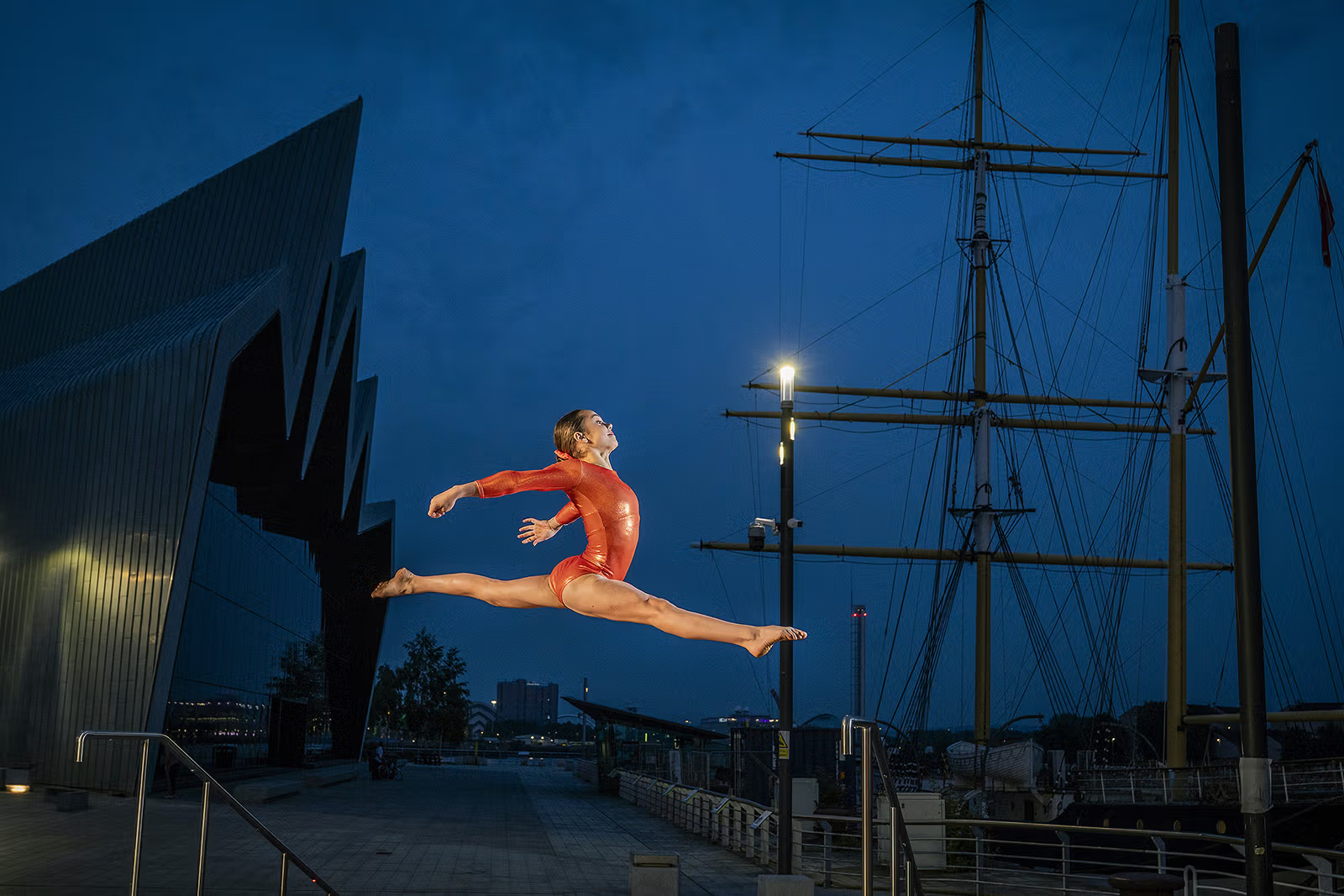
The campaign opens with two independently composed photographs made at the same Riverside Museum location. They are not alternative crops of one master frame. Each photograph was created separately to give editors and communications teams a publication-ready landscape or portrait option, with appropriate space, balance and architectural context for its intended format.


Riverside Museum • Movement • Landscape and Portrait
Riverside Museum’s folded roofline and open landward plaza gave Indira Williams space to perform expressive jumps while keeping Glasgow’s contemporary architecture central to the campaign. The landscape and portrait photographs were composed separately rather than derived from a single frame.


Riverside Museum • Strength • Structural Lines
Aaron Convery’s controlled positions echo the museum’s strong horizontal and angular forms. The parallettes, stone blocks and open architectural lines identified during the recce became purposeful elements within the final compositions.


Kelvingrove • After Dark • A Different Visual Language
Kelvingrove changed the visual rhythm of the campaign. The illuminated entrance and sandstone façade created a more theatrical setting, while moving red light introduced energy around the athletes without obscuring their expressions, body lines or controlled positions.


A PR photographer assignment with more at stake than a single picture
Communications campaigns often appear effortless once the finished photographs are published. A strong portrait occupies the top of a press release, a landmark gives the story an immediate sense of place and the people at the centre of the campaign look relaxed, confident and relevant. What the final image does not reveal is the judgement that made it possible.
Tin Man Communications developed the campaign strategy for EDF and commissioned UNP to create the editorial image library that would carry the story visually. The brief required more than an available photographer with a camera. It required a Glasgow PR photographer who could assess prominent city locations, understand how each would work at different times of day, anticipate press and corporate usage, and translate a communications idea into a coherent collection of publishable pictures.
The campaign centred on EDF apprentices Aaron Convery and Indira Williams, both accomplished gymnasts. Their portraits needed to communicate energy, precision and ambition while remaining credible within a corporate and editorial campaign. Glasgow could not sit in the background as decoration. The city needed to contribute visual scale, geographic recognition and editorial meaning.
Four locations were examined: Riverside Museum, Kelvingrove Art Gallery and Museum, The Mitchell Library, and the Gallery of Modern Art with the Duke of Wellington statue. Each was photographed at sunrise and again approaching sunset. Landscape and portrait viewpoints were assessed separately because a vertical editorial image is not simply a crop from a wider horizontal frame.
Independent publication evidence
Editorial publication and campaign reach
The value of a commissioned PR photography assignment is ultimately demonstrated by how effectively the finished images support the campaign beyond delivery. The examples below document the Glasgow photography progressing into national newspaper coverage, consumer and digital media, EDF’s official corporate communications and regional newspaper publication.
Together, these independently published articles provide a verifiable record of campaign reach. They show that the photographs were not created simply for a portfolio, but supplied as usable editorial assets that entered a live communications campaign and reached audiences across the United Kingdom.

National editorial coverage using commissioned photography created by UNP photographer Chris Watt for EDF and Tin Man Communications during the Glasgow assignment.
View original article
National digital news coverage using photography commissioned by Tin Man Communications for EDF and produced by UNP photographer Chris Watt in Glasgow.
View original article
Consumer editorial coverage featuring the commissioned EDF campaign photography created at Riverside Museum by UNP photographer Chris Watt.
View original article
Wider digital publication of the EDF campaign using commissioned photography produced during the Glasgow assignment and delivered through the UNP National Picture Desk.
View original article
EDF’s official Media Centre publishing the completed campaign photography commissioned through Tin Man Communications and created by UNP photographer Chris Watt.
View original article
Regional newspaper coverage using the commissioned EDF photography, demonstrating the campaign’s relevance across local and national editorial environments.
View original articleAgency publication
Corporate communications
Regional newspaper publication
- Clydebank Post
- Darlington & Stockton Times
- Greenock Telegraph
- Hackney Gazette
- Hillingdon Times
- Salisbury Journal
Every publication shown above forms part of the documented record of this commissioned assignment. The screenshots are reproduced solely as documentary evidence of independent publication and remain the copyright of their respective publishers. The underlying campaign photography is © UNP / Chris Watt, commissioned and coordinated through the UNP National Picture Desk.
Creative collaboration between agency, client, photographer and Picture Desk
Successful national communications campaigns are rarely the work of one person. Tin Man Communications created the strategic and creative framework. EDF was the client and the organisation whose apprentices were being represented. Chris Watt brought local Glasgow knowledge, press judgement and the ability to work confidently with athletes in live public locations. The UNP National Picture Desk connected those elements through one managed route for briefing, scheduling, commissioning, delivery and editorial consistency.
That distinction is important. UNP was not claiming ownership of the communications strategy. Its responsibility was to interpret the campaign visually and supply images that could withstand real editorial use. That meant listening closely to the agency, understanding the client’s requirements, selecting a photographer whose experience matched the brief and making sure the final files were more than attractive photographs: they had to be usable campaign assets.
The assignment also demonstrates the purpose of a managed photographer network. A local photographer can contribute knowledge that no distant production team can replicate, but local knowledge alone does not guarantee national campaign consistency. The Picture Desk provides the bridge: one brief, one standard, one point of accountability and one delivery workflow, while the selected photographer makes informed decisions on the ground.
Twenty-four photographs that make the planning visible
It is easy for an agency to say that it plans carefully. The recce archive below makes that claim testable. It records the four locations under two different light conditions and includes both landscape and portrait studies. The sequence reveals what was available, what would have been difficult and why Riverside Museum and Kelvingrove ultimately provided the strongest combined solution.
Riverside Museum offered the River Clyde, the Tall Ship Glenlee, modern architecture, open public space, railings, stone blocks and several distinct directions of view within one compact area. Kelvingrove offered a contrasting visual language: historic sandstone, formal symmetry, a central illuminated arch and strong vertical scale after dark. Together, the two locations could create variety without making the campaign feel disconnected.
The Mitchell Library was authoritative and recognisably civic, but roads, parked vehicles and more limited working distances reduced the flexibility available for broad gymnastic movement. The Gallery of Modern Art and Duke of Wellington statue were unmistakably Glasgow, yet the statue, public art, traffic and pedestrian activity risked competing with the commissioned subjects. Those are not criticisms of the locations. They are reasons grounded in the needs of this particular campaign.
Glasgow campaign recce archive
Four Glasgow locations. Sunrise and sunset. Landscape and portrait.
The complete recce archive shows the alternatives assessed before the commissioned EDF campaign. Each frame forms part of the evidence: local knowledge, repeat visits, working-space assessment and publication-led composition coordinated through the UNP National Picture Desk.
Riverside Museum • River Clyde • Tall Ship Glenlee • Open Working Space
Riverside Museum provided the broadest range of possibilities within one location: unmistakable Glasgow context, modern architecture, waterfront depth, open plaza space, railings for controlled strength poses and stone blocks that could support separate portrait compositions.


Kelvingrove Art Gallery and Museum • Symmetry • Sandstone • Evening Illumination
Kelvingrove introduced visual authority and contrast. The sunrise studies established scale and working distance; the evening studies showed how the central entrance, internal illumination and sandstone façade could support more dramatic campaign portraits after dark.


The Mitchell Library • Civic Architecture • Dome • Practical Constraints
The Mitchell Library offered a distinctive dome and formal civic presence, but the recce also recorded the realities of roads, parked vehicles, pedestrian access and the more limited space available for large athletic movement and controlled lighting.


Gallery of Modern Art • Duke of Wellington • Glasgow Identity • Visual Competition
The Gallery of Modern Art and Duke of Wellington statue offered instant Glasgow recognition. The same strength created the central challenge: the existing landmark, public art, traffic and pedestrians could easily become more dominant than the apprentices at the centre of the EDF campaign.


Why Riverside Museum and Kelvingrove became the final campaign locations
The final choice was not based on selecting the two most famous Glasgow landmarks. It was based on what the pair could achieve together. Riverside Museum offered movement, open space and contemporary architecture beside the River Clyde. Kelvingrove offered formality, symmetry and a richly illuminated historic façade. The contrast gave the completed image library breadth while preserving a consistent Glasgow identity.
Riverside could support wide establishing frames, waterfront portraits, individual athletic movements and vertical images with space for editorial design. The railings beside the Tall Ship Glenlee could accommodate Aaron Convery’s controlled strength work, while the open plaza gave Indira Williams room for a split leap without losing the museum or ship from the wider story. The stone blocks on the landward side created a second visual setting without requiring a separate transfer across the city.
Kelvingrove then changed the campaign’s mood. As the ambient light fell, the central entrance and sandstone architecture became more dramatic. The symmetrical façade offered a strong visual frame for individual portraits, while controlled lighting and movement could prevent the photographs from becoming static. The result was not repetition at a second landmark, but a complementary set of assets with a different editorial character.
The Mitchell Library and Gallery of Modern Art remained credible alternatives, and the recce photographs preserve the reasons they were considered. Their inclusion matters because it demonstrates choice. A campaign location has greater evidential value when the alternatives and constraints are visible, not hidden.
Landscape and portrait are different campaign photographs
Modern communications teams rarely commission one image for one destination. A press release may require a horizontal lead image. A mobile article, presentation cover or social story may require a vertical frame. Corporate websites may need negative space for headlines. Internal communications may need portraits that remain clear at smaller sizes. Treating every format as an afterthought weakens the final library.
The Glasgow recce therefore assessed landscape and portrait compositions separately. The vertical studies at Riverside Museum, Kelvingrove, The Mitchell Library and the Gallery of Modern Art were not casual rotations of the camera. They tested how architecture, sky, foreground and potential subject placement would work within a genuinely different publishing shape.
That planning matters commercially. A campaign that receives both orientations as properly composed photographs has more value than one supplied with a series of wide images that designers must crop aggressively. It also protects the subjects and client branding from being pushed to the edge of a frame when the same photograph is adapted across multiple channels.
Building an editorial image library rather than chasing one hero frame
A hero photograph matters, but a national campaign cannot depend on one successful frame. Editors, corporate communications teams and digital publishers need choice. They need close and wide images, individual and paired portraits, landscape and portrait orientations, action and quieter moments, recognisable location and cleaner alternatives.
The selected Glasgow locations made that variety possible. At Riverside Museum, the campaign could move between the River Clyde, Tall Ship Glenlee, waterfront railings, open plaza and the museum’s landward façade without losing visual continuity. At Kelvingrove, the central entrance and illuminated sandstone architecture provided a second family of pictures with a distinct mood but the same campaign identity.
This is where a PR photographer differs from someone simply recording an appearance. The commission is judged by the usefulness of the complete delivery. Every frame should contribute something: a clear lead image, an alternative crop, geographic context, subject personality, corporate relevance or a format that solves a real publishing requirement.
The role of the UNP National Picture Desk
The photographer creates the pictures, but the assignment begins and ends with coordination. The UNP National Picture Desk receives the brief, clarifies usage and outputs, identifies the right regional photographer, manages availability, communicates changes, keeps the agency and photographer aligned and oversees delivery of press-ready files.
For this commission, that meant connecting Tin Man Communications and EDF with Chris Watt’s Glasgow knowledge while preserving one consistent route for campaign management. The Picture Desk did not replace the photographer’s judgement. It created the conditions in which that judgement could serve the wider brief.
The same model applies when an assignment expands beyond one city. A communications team can commission photographers in Glasgow, London, Manchester, Cardiff, Belfast or multiple regional sites without separately sourcing and briefing unrelated suppliers. Local experience remains local; campaign standards remain central.
Commissioning a PR photographer in Glasgow?
Whether an assignment requires one photographer in Glasgow or forms part of a wider UK campaign, UNP combines experienced local photographers with one central Picture Desk for briefing, coordination, image standards, captioning and press-ready delivery.
For a Glasgow assignment, the UNP Glasgow photographer service provides the local route, while the UNP Picture Desk can coordinate the wider communications requirement where PR, press, corporate or multi-location photography overlaps.
If your brief needs a Glasgow PR photographer, send the Picture Desk the date, location, people involved, intended image uses, access requirements and delivery deadline. UNP can then build the assignment around how the photographs will actually need to work.


